Make EF Core queries faster
Move a filter into SQL so your app stops loading the whole table.
Try the EF Core exercise →The proving ground for .NET developers
Graded C# and .NET katas: algorithms held to time and allocation budgets, EF Core and SQL queries measured on a real database down to the execution plan, plus architecture, refactoring, secure coding, and test writing.
Solve Two Sum in the real editor. Create an account only after you pass.
All three are free. No account or setup needed.
Move a filter into SQL so your app stops loading the whole table.
Try the EF Core exercise →Flatten nested null checks while keeping the existing behavior intact.
Try the refactoring exercise →Replace a slow pair-by-pair search with a hash map, then check the result.
Try the algorithm exercise →Each exercise opens a longer Pro learning path. See the paths →
✓ 2 more visible tests passed
Code submissions are measured like this: per test, on the server.
Two ways to practice
Train one engineering skill at a time, or follow a structured course through executable projects. Both make you write the code and prove the result.
Puzzles
Solve a bounded problem, submit against hidden tests, and get production-grade feedback on correctness, performance, allocations, database plans, structure, or security.
Explore C# coding challenges →Katabench Labs
Preview the 4-lesson transactional outbox lab. See how a small .NET service loses order events and the changes that fix it, while its live workspace completes private-beta validation.
Preview the Outbox lab →Also in Labs: async APIs and the Aspire CLI.
The disciplines
Algorithm drills are the smallest part of the job. Each code discipline trains a different fundamental of the craft. System Design adds a visual eighth practice surface.
Classic problems where correct is only halfway: hidden 200,000-element gates time out the O(n²) pass, and allocation budgets (measured by the GC, not estimated) fail the copy-happy one.
LINQ against a real PostgreSQL database. The grader captures the execution plan the engine actually chose, and grades it. Kill the N+1, earn the index scan.
Inherit working-but-awful code (including the famous Gilded Rose) and clean it up. Roslyn measures complexity, nesting, duplication, and method length while every test stays green.
Multi-file katas graded on design itself: dependency direction, layer isolation, extracted interfaces, sealed types. A wrong dependency fails the same way a failing test does.
Fix vulnerable-but-working code against real attack payloads: path traversal, SQL injection, SSRF, open redirect. Block the exploit without breaking the feature.
Small katas on the principles behind the patterns: make a value object truly immutable, seal an aggregate's invariants, invert a dependency. Graded on structure, not just behavior.
You write the tests. Your suite runs against a correct implementation and a set of planted-bug mutants, and passes only when it catches enough of them. Coverage that has to actually detect bugs.
514
graded puzzles and counting
Every one with a gate that green checkmarks can't fake, and new puzzles ship with every release.
Each card opens the focused practice catalog for that discipline. Prefer an ordered curriculum? Follow the C# and .NET learning paths.
Build a provider-neutral topology on a rich canvas. Deterministic rules check its paths, service boundaries, redundancy, messaging, storage, security, and observability, then a real lesson explains the tradeoffs after you solve it.
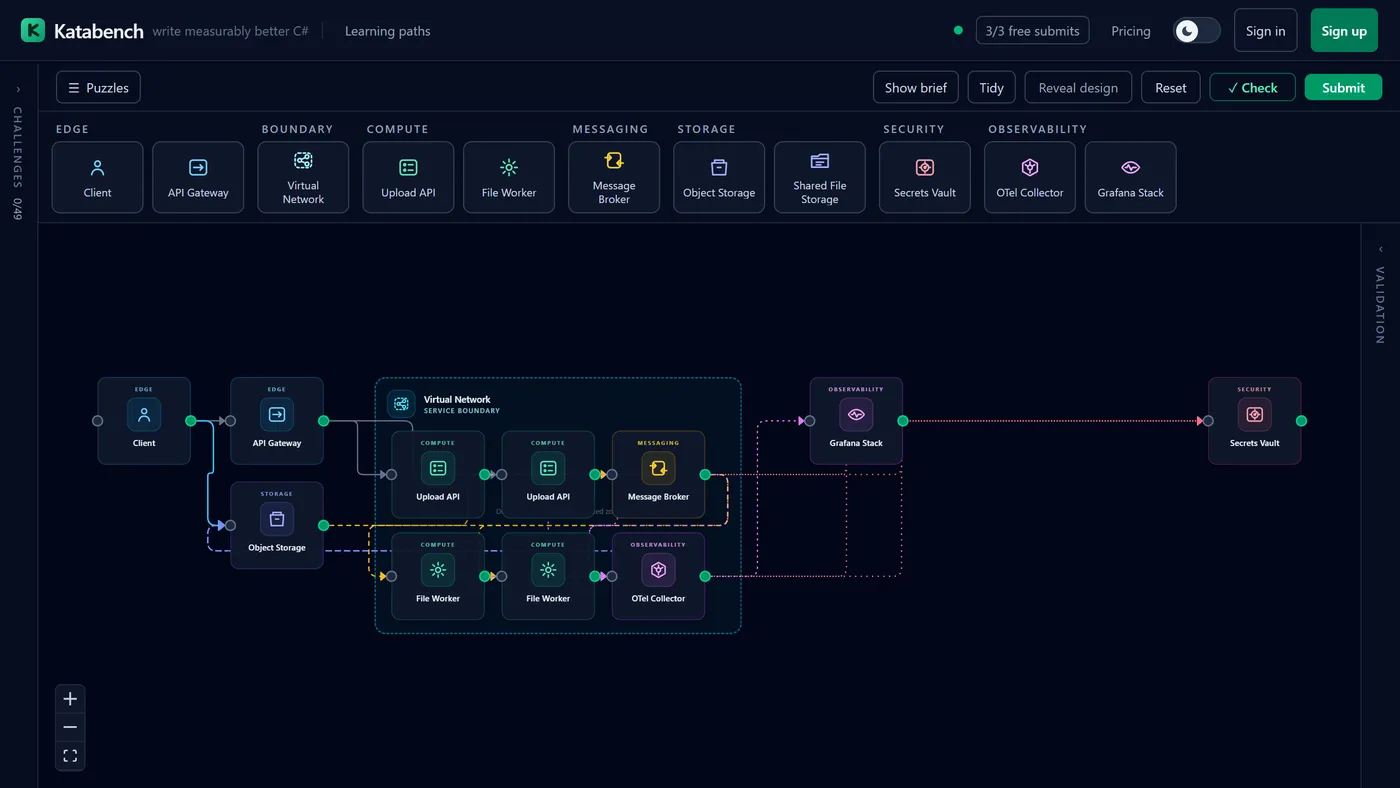
Exhibit A
Submit LINQ and we run it on a real PostgreSQL instance seeded with tens of thousands of rows, capture the execution plan the engine actually chose, and grade the plan itself. Getting the right rows the wrong way is a visible, gradeable mistake here. Start with the ordered LINQ exercises, or explore the full set of EF Core exercises built around that feedback loop.
The obvious filter
.Where(t => t.TappedAt.AddHours(offset).Year == year && t.TappedAt.AddHours(offset).Month == month)
Sort (by id)
Seq Scan on taps
60,000 rows read · ⚠ full table read
✗ 1 / 3 plan rules hold
The sargable rewrite
.Where(t => t.TappedAt >= start && t.TappedAt < end)
Sort (by id)
Index Scan on taps using ix_taps_tapped_at
100 rows read · ✓
✓ 3 / 3 plan rules hold
Same rows returned. Same green tests. Only one earns the index scan, and the grade.
The plan comes from the database that just ran your query on realistic data, not a simulation, not a guess.
Full-table reads called out in red, index usage in green, row estimates on every node, even on hidden tests.
No full-table scan, must use the index, one round-trip: pass/fail rules evaluated against the captured plan.
Seven code tracks plus the System Design beta, Easy to Hard. Each puzzle states the goal, the constraints, and the bar you have to clear: a time budget, an allocation ceiling, a plan rule, a design rule.
Run visible cases in the code editor, or build a topology and Check its paths, boundaries, redundancy, and dangerous bypasses. Iterate before the final grade.
Your solution faces the discipline-specific grader: hidden tests and metrics for code, or deterministic semantic rules for a system topology.
Code runs in a hardened disposable sandbox. System Design topologies are validated and graded as bounded data, without executing learner code. See exactly what happens →
Guided Learning Paths
Follow a deliberate sequence across algorithms, data access, refactoring, architecture, and secure coding. The path supplies the curriculum. Katabench still makes you prove every step against real correctness, performance, query-plan, and structure gates.
Database and EF Core
High-Performance Data Access
The grader
One platform, discipline-specific evidence. Every verdict is evaluated where it cannot be faked.
Every test reports server-measured elapsed time against its budget plus managed-heap allocations, median of repeated runs, so a GC pause can't flip your verdict. Some puzzles set hard budgets: a 100 KB input under a 16 KB allocation ceiling forces the in-place solution.
Database puzzles run on a real PostgreSQL instance seeded for your submission. Expand any test to see every SQL statement your LINQ produced, what it cost, and the plan the engine chose.
Refactoring katas parse your source and measure it: cyclomatic complexity, nesting depth, method length, duplicate blocks. The tests stay green, the mess has to go.
Dependency direction, layering, abstractions, and sealed types are verified on every submission. A wrong dependency fails the grade, not a code review three weeks later.
Secure-coding puzzles run a second, adversarial suite: traversal strings, SQL-injection payloads, forged log lines, SSRF probes at the cloud metadata endpoint. Exploits blocked and behavior preserved. Both, or no pass.
Give up gracefully: load a correct, optimal reference solution into the editor, study it, then reset and try to beat it from memory.
Learning Paths give you the route. The proving ground makes you apply it, defend it, and earn the progress that shows it stuck.
You watch
Great for absorbing new concepts, but nothing measures whether you can actually apply them under constraints.
You pass
Binary right/wrong on correctness, optimized for getting hired. An O(n²) pass teaches the wrong lesson.
You get sharper
Graded on the qualities production actually judges, so what you practice here transfers to the job. Progress reflects proof, not time spent watching.
Learn concepts anywhere. Prove the skill here. Built by a working .NET engineer and educator, for the engineers who want their practice to count.
Start free, no credit card. Go Pro for the Database, Refactoring, Architecture, and Secure Coding tracks, every guided path, and no daily cap.
The full algorithm catalog, graded. No credit card.
Freeforever
The full proving ground: every premium track, every gate, no daily cap.
$19/mo
For people training hard: more parallel runs, first access to new tracks, and direct support.
$39/mo
Pick a puzzle, press Run, and see how fast your code really is. Then make it faster.
Try it free, no signup